

In 2026, content creation is no longer about working harder — it’s about working smarter with AI. Businesses, creators, and faceless brands are using AI content automation to produce high-quality blogs, reels, and social posts in a fraction of the time.
If you want more traffic, faster growth, and scalable content production, this deep guide will show you exactly how AI content automation works, which tools to use, and how to build a workflow that actually ranks on Google.
Following Google helpful content guidelines ensures your AI-assisted content can rank safely.If you’re new to this space, start with our complete AI automation for beginners guide to understand the fundamentals.
🚀 What Is AI Content Automation?
AI content automation is the process of using artificial intelligence tools to plan, create, optimize, publish, and sometimes distribute content automatically with minimal human effort.
Instead of manually:
- researching topics
- writing content
- creating images/videos
- posting on social media
AI handles most of the workflow.
Simple definition:
👉 AI + workflow + minimal human input = automated content machine
According to AI content automation best practices, helpful and user-focused content performs better in search.
🎯 Why AI Content Automation Is Exploding in 2026
Content demand has increased massively, but manual creation is slow and expensive. AI solves three major problems:
✅ Speed
AI can generate blogs, captions, and scripts in seconds.
✅ Scalability
You can produce 10x more content without hiring a big team.
✅ Cost Reduction
Many businesses cut content costs by 50–80%.
✅ Consistency
Automated workflows ensure regular posting — which Google and social media algorithms love.
🔥 Real Benefits for Bloggers & Faceless Creators
If you run a blog, Pinterest, Instagram, or YouTube channel (like faceless brands), AI automation gives you:
- Faster blog publishing
- Bulk content creation
- Automated social media posting
- SEO optimization assistance
- Idea generation on demand
- 24/7 content pipeline
Result: More traffic with less manual work.Many companies use AI to improve business productivity with AI-powered workflows.

🧠 How AI Content Automation Works (Step-by-Step Pipeline)
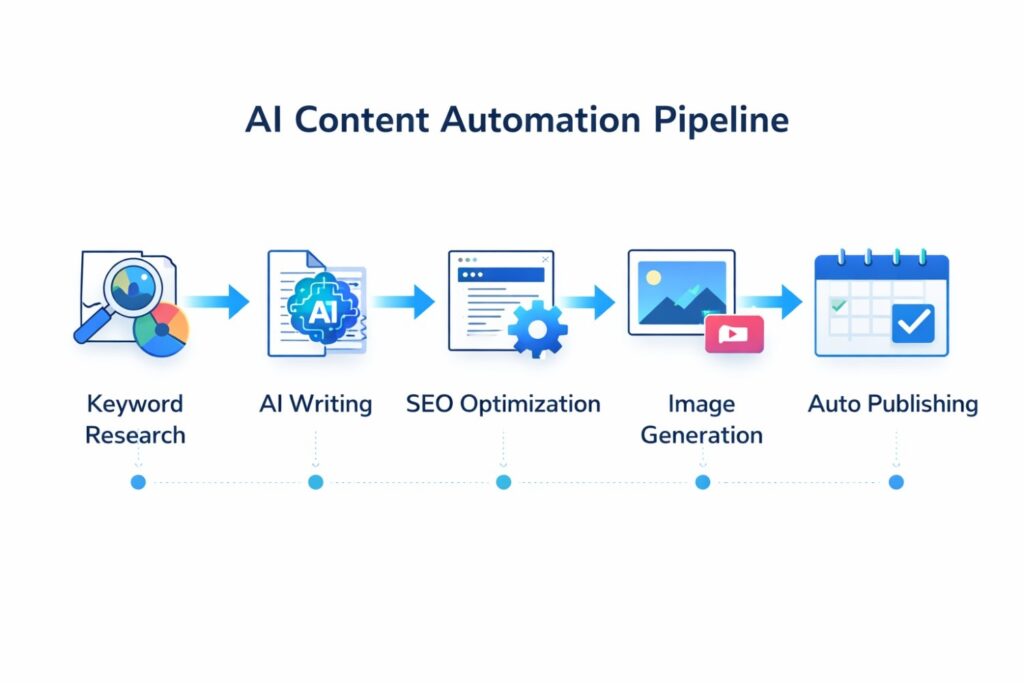
A professional AI content system usually follows this pipeline:
Step 1: Topic Research Automation
AI tools find trending and low-competition keywords.
Goal: Target what people are actually searching.
Popular tasks:
- keyword discovery
- search intent analysis
- competitor research
Step 2: AI Content Generation
The AI writes:
- blog drafts
- video scripts
- captions
- product descriptions
⚠️ Important: Raw AI output should always be human-edited for best SEO performance.You can speed up your workflow using our AI automation script generation tool for instant content drafts.
Step 3: AI SEO Optimization
Smart tools optimize:
- headings
- keyword density
- readability
- meta description
This step helps content rank higher on Google.
Step 4: AI Image & Video Creation
Automation now includes:
- blog featured images
- Pinterest pins
- Instagram reels
- faceless YouTube videos
This is where faceless creators get massive advantage.
Step 5: Auto Publishing & Scheduling
Final step is automation of:
- WordPress publishing
- Pinterest scheduling
- Instagram posting
- email distribution
Goal: Fully hands-off content machine.
🛠️ Best AI Content Automation Tools in 2026
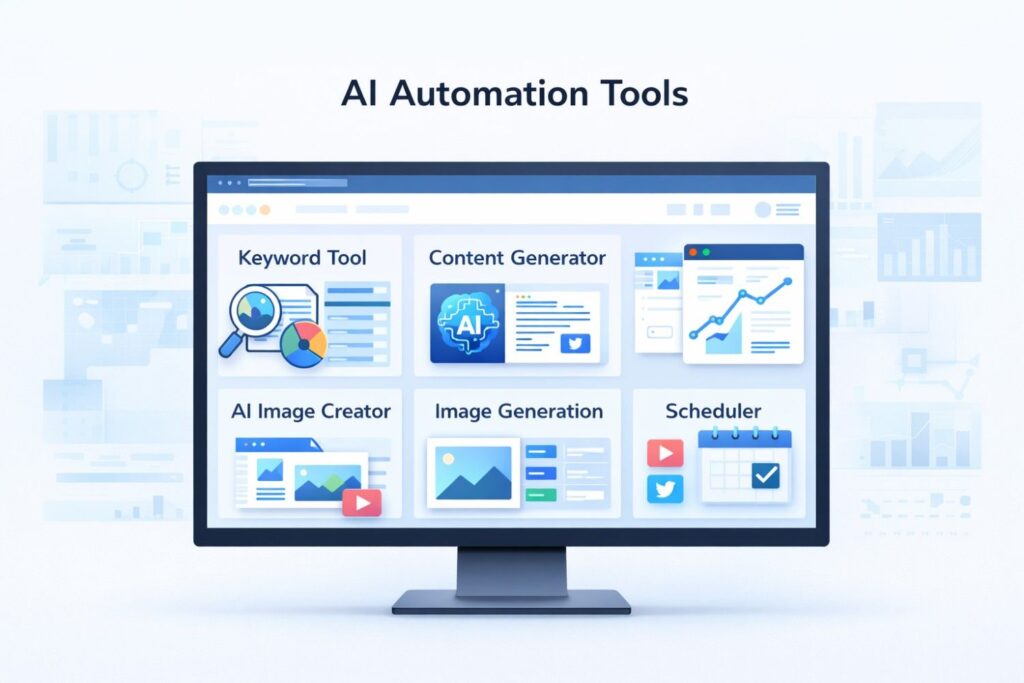
Here are the most effective categories (not hype — practical use):
✍️ Writing & Script Tools
Best for:
- blog posts
- scripts
- captions
- outlines
Look for tools that support:
- long-form generation
- SEO mode
- tone control
- plagiarism checking
🎨 AI Image Generators
Used for:
- blog thumbnails
- Pinterest pins
- social media visuals
High-quality visuals increase CTR and engagement.
🎬 AI Video Automation Tools
Perfect for faceless channels:
- auto subtitle generation
- text-to-video
- AI voiceovers
- reel automation
This niche is growing extremely fast.
⚙️ Workflow Automation Tools
These connect everything together.
Example automations:
- blog publish → auto Pinterest pin
- new article → auto tweet
- video upload → auto caption
This is the real power of AI automation.Explore these best automation tools to build a fully hands-off content system.
💡 Complete AI Content Automation Workflow (Beginner Friendly)
Here is a practical workflow you can follow:
Daily Workflow
- Find keyword using AI
- Generate blog draft
- Human edit + add experience
- Create AI featured image
- Optimize SEO
- Publish on blog
- Auto-share to Pinterest/Instagram
⏱️ Time required after setup: 30–60 minutes per post
📈 SEO Best Practices (Very Important for Ranking)
To actually rank on Google, follow these rules:
✅ Add Human Experience
Google prefers helpful, experience-based content.
Do this:
- add examples
- add tips
- add real workflows
- add pros/cons
✅ Use Proper Keyword Placement
Include main keyword in:
- title
- first 100 words
- H2 headings
- meta description
- image alt text
But avoid keyword stuffing.
✅ Focus on Search Intent
For AI content automation keyword, users want:
- how it works
- tools
- step-by-step guide
- real workflow
Your content must satisfy intent.
✅ Maintain Readability
- short paragraphs
- clear headings
- bullet points
- simple language
Google rewards helpful structure.
⚠️ Common Mistakes to Avoid
Many beginners fail because of these:
❌ publishing raw AI content
❌ no human editing
❌ keyword stuffing
❌ thin content
❌ ignoring internal linking
❌ no content strategy
Golden rule: AI should assist — not fully replace human value.
🔮 Future of AI Content Automation

The next wave is already forming:
- agentic AI workflows
- multi-AI content teams
- real-time personalization
- fully autonomous content pipelines
Creators who adopt early will dominate search and social platforms.Reports on the future of AI in content creation show rapid growth in automated workflows.The future of AI automation points toward fully autonomous content systems.
🎯 Final Thoughts
AI content automation is not just a trend — it is becoming the standard way modern creators and businesses scale content.
If implemented correctly, it can:
- multiply your output
- grow traffic faster
- reduce workload
- build passive content systems
Start simple, build your workflow step-by-step, and focus on helpful human-enhanced AI content — that is what ranks in 2026.
Frequently Asked Questions (FAQs)
1. What is AI content automation?
AI content automation is the use of artificial intelligence tools to automatically create, optimize, schedule, and publish digital content such as blog posts, social media updates, emails, and marketing copy with minimal human effort.
2. How does AI content automation work?
It typically follows a workflow: keyword research → AI writing → SEO optimization → image generation → scheduling → auto publishing. Machine learning models analyze data and generate content based on prompts and predefined rules.
3. Is AI-generated content good for SEO?
Yes—when used properly. AI content can rank well on Google if it is:
- Original and plagiarism-free
- Helpful and user-focused
- Properly optimized with keywords
- Edited and fact-checked by humans
Google rewards quality, not whether AI was used.
4. Can AI completely replace human writers?
No. AI is best used as a productivity assistant, not a full replacement. Human editing, creativity, fact-checking, and brand voice refinement are still essential for high-quality content.
5. Which tasks can be automated with AI content automation?
Common automated tasks include:
- Blog writing
- Social media post creation
- Email marketing
- SEO optimization
- Image generation
- Content scheduling and publishing
6. Is AI content automation safe for beginners?
Yes. Many modern AI tools are beginner-friendly and require no coding skills. However, beginners should still review AI output to ensure accuracy and quality.
7. What are the main benefits of AI content automation?
Key benefits include:
- Saves time and effort
- Increases content production speed
- Reduces marketing costs
- Improves workflow efficiency
- Enables scalable content strategies
8. What are the risks of using AI for content creation?
Potential risks include:
- Generic or repetitive content
- Factual inaccuracies
- Over-automation without human review
- Possible duplicate content if misused
These risks can be minimized with proper editing and strategy.
9. How can businesses use AI content automation effectively?
Businesses should:
- Use AI for first drafts
- Add human editing and brand voice
- Focus on helpful, user-intent content
- Monitor analytics and improve continuously
10. Is AI content automation the future of digital marketing?
Yes. AI automation is rapidly becoming a core part of modern digital marketing workflows. Businesses that adopt AI strategically are likely to gain a strong competitive advantage.
It’s the best time to make a few plans for the future and it’s time to be happy.
I’ve read this publish and if I could I want to counsel you few interesting issues or tips.
Perhaps you can write subsequent articles relating to this article.
I desire to learn even more issues approximately it!
Thank you so much for your kind words! I’m glad you enjoyed the post. I really appreciate your suggestions and will definitely consider writing more articles on this topic. Stay tuned for more!
Its like you read my mind! You seem to know a lot about this, like you wrote the book in it or something.
I think that you could do with a few pics to drive the message home a bit,
but other than that, this is wonderful blog. An excellent read.
I’ll definitely be back.
Thank you so much! I’m really glad you enjoyed the blog. I appreciate your suggestion about adding pictures—will definitely keep that in mind. Looking forward to having you back.