
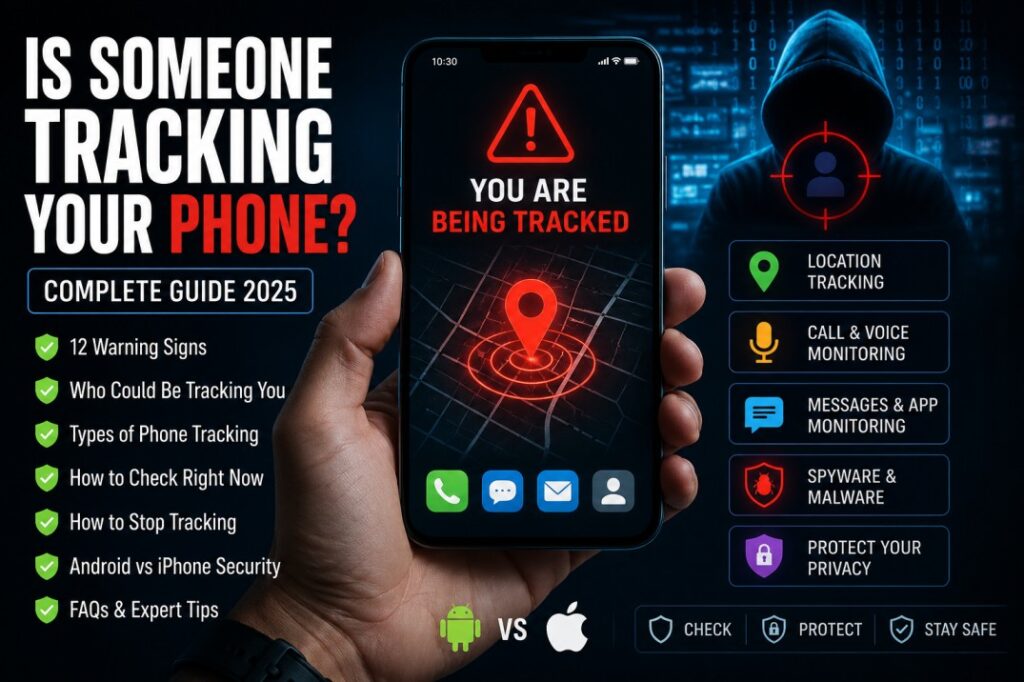
Is Your Phone Being Tracked Right Now?
Your phone knows where you sleep. It knows where you work, who you call at 2am, which routes you drive, what you search at midnight, and how long you stood outside your ex’s apartment last Tuesday. That’s not a conspiracy theory — that’s just how smartphones work in 2025.
The real question isn’t whether your phone is collecting data. It’s who else has access to it. A jealous partner. A controlling family member. A hacker who slipped stalkerware onto your device. A corporation quietly monetizing your location. Government surveillance. Or all of the above.
“Most people who are being tracked have no idea. The signs are subtle — a battery that drains faster than usual, a phone that stays warm when idle, data charges you didn’t make. Miss them once and you miss everything.”
This guide — and the free 60-second checker below — exists for one reason: to give you clarity. Not paranoia. Clarity. After taking the quiz and reading this article, you’ll know exactly where you stand and precisely what to do about it.
1 in 4
Smartphones have spyware installed by someone the owner knows
96%
Of stalking victims say their stalker used tech to monitor them
$12B
Global spyware market value in 2024 — growing 15% annually
67%
Of victims didn’t notice tracking for over 6 months
📋 What You’ll Learn In This Article
- 01 Free 60-Second Phone Tracking Checker (Take First)
- 02 12 Warning Signs Your Phone Is Being Tracked
- 03 Who Could Be Tracking You — and How
- 04 5 Types of Phone Tracking Explained
- 05 How to Check Your Phone Right Now (Step-by-Step)
- 06 How to Stop Phone Tracking Completely
- 07 Android vs iPhone: Which Is Safer?
- 08 Frequently Asked Questions
🔍 Free Checker Tool
# Phone Tracking Detection Tool – WordPress HTML Code “`htmlIs Your Phone Being Tracked?
Answer a few questions below to check for possible signs that your phone may be monitored or tracked. This tool provides general indicators only and does not guarantee detection.
1. Does your phone battery drain unusually fast?
2. Does your phone become hot even when not in use?
3. Do you notice strange background noises during calls?
4. Are random apps appearing on your phone?
5. Is your mobile data usage unusually high?
Tracking Analysis Result
Safety Tips
- Update your phone software regularly.
- Remove unknown apps immediately.
- Use strong passwords and 2FA.
- Install apps only from official stores.
- Run trusted antivirus/security scans.
12 Warning Signs Your Phone Is Being Tracked
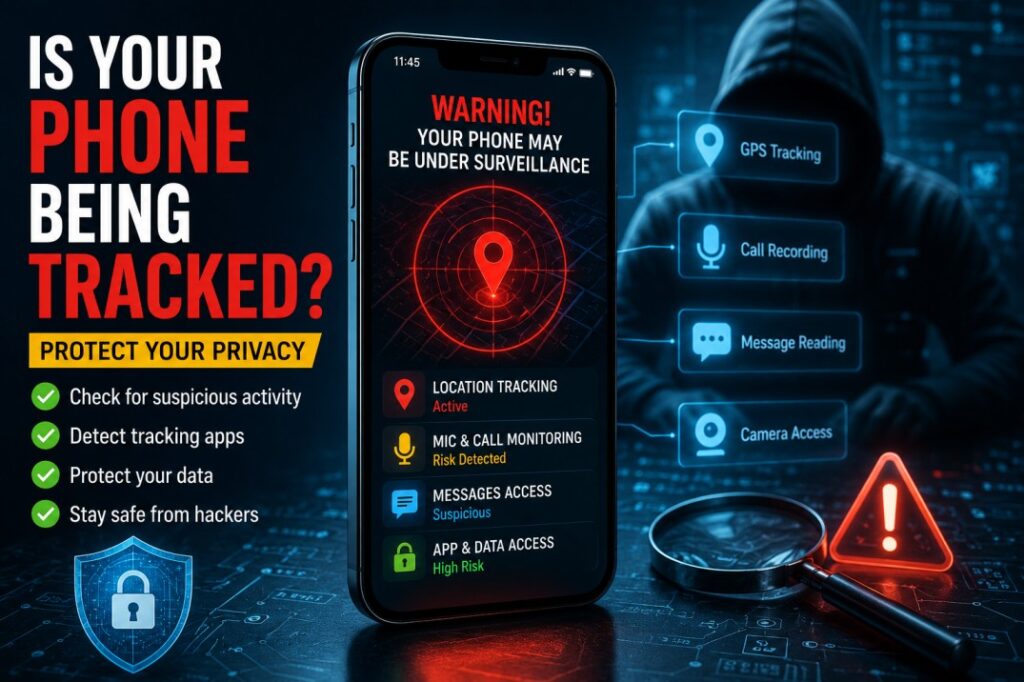
Most tracking software is designed to be invisible. It runs silently in the background, hides its icon, and operates just below the threshold of what you’d notice day-to-day. But no software is perfect. Here are the 12 most reliable signs that something is monitoring your phone — and what each one means.
- 1 Battery draining significantly faster than usualTracking apps run continuously, using GPS, microphone, and internet simultaneously. A phone that used to last 18 hours suddenly dying at 11 hours is one of the strongest indicators. Especially suspicious if the drain happens even when you’re not using the phone.
- 2 Phone feels warm when idle or sleepingA phone sitting on a desk should be at room temperature. If yours is warm — especially on the back — something is processing data. Spyware uploading your location, messages, or audio recordings generates heat even when the screen is off.
- 3 Unexplained spike in mobile data usageStalkerware transmits your data — photos, messages, location pings, call logs — to a remote server. This costs data. Check your settings: Settings → Mobile Data → see which apps consumed the most. An app you don’t recognize using hundreds of MB is a red flag.
- 4 Strange sounds during phone calls (clicks, static, echoing)While modern wiretapping is often silent, some poorly implemented interception software creates audible artifacts — faint clicking, slight delays, or your own voice echoing back to you. These sounds are more common with call-recording malware on older devices.
- 5 Apps you didn’t download appear on your phoneGo through every app on your device. If you see something you don’t recognize — especially apps with vague names like “System Service,” “Phone Monitor,” or “Sync Manager” — don’t assume it’s harmless. Google it immediately before doing anything else.
- 6 Phone takes noticeably longer to shut downWhen you power off your phone, it typically closes all apps and processes. If a tracking app is transmitting data as you initiate shutdown, the device will pause before powering off — sometimes for 10–30 seconds longer than usual. This is often overlooked but surprisingly telling.
- 7 Screen lights up when not in useIf your screen occasionally activates when you receive no notifications and touch nothing, an app may be making background requests. Some stalkerware “wakes” the screen as a side effect of its data transmission routines.
- 8 Someone always seems to know your location or conversationsThis is the most obvious human signal — not a technical one. If a specific person consistently knows where you’ve been, what you discussed privately, or references things you never told them, the source is almost certainly your phone, not coincidence.
- 9 Autocomplete suggests things you’ve never typedYour keyboard learns from what you type. If your keyboard autocomplete suggests words, names, or phrases that are completely foreign to your usage — particularly after someone else briefly had your phone — it may mean a keylogger has been installed that altered your keyboard behavior.
- 10 Unusual permission requests from system appsIf a calculator app requests microphone access, or a weather app suddenly wants access to your contacts and camera — something is wrong. Legitimate system apps don’t need unusual permissions. Stalkerware often disguises itself as harmless utilities before requesting broad access.
- 11 Phone performance has suddenly degradedApps running slowly, animations stuttering, or your phone lagging during basic tasks can indicate a background process consuming CPU resources. Tracking apps are poorly optimized and often drag down the entire device — especially on mid-range phones with limited RAM.
- 12 Your phone bill shows calls or texts you didn’t makeSome spyware sends SMS or makes calls to forward your data using your carrier connection. These show up on your bill. If you see numbers you don’t recognize in your outgoing log — especially at odd hours — this warrants immediate investigation.
⚠️
Important: One sign alone may not indicate tracking
A warm phone could mean you’ve been running GPS navigation. Fast battery drain could be a degraded battery. However, if you notice 3 or more of these signs together — particularly alongside a specific person who seems to know too much — take it seriously and follow the steps in Section 5.
👤 Threat Source
Who Could Be Tracking You — and How
Understanding who might be tracking you is just as important as understanding how. The motivation shapes the method, and the method tells you where to look. Here are the five most common sources of unauthorized phone surveillance in 2025.
1. Intimate Partners and Ex-Partners
This is the most common source of phone tracking. Research consistently shows that the majority of stalkerware installations are done by someone who had physical access to the victim’s phone — a partner, ex-partner, or family member. They install apps like FlexiSPY, mSpy, or Hoverwatch during a moment alone with your device. These apps are marketed as “parental monitoring” tools but are frequently used for coercive control.
2. Hackers and Cybercriminals
Unlike intimate-partner surveillance, criminal hackers typically don’t have physical access to your phone. Instead, they exploit vulnerabilities through phishing links, malicious apps downloaded from unofficial sources, fake Wi-Fi hotspots, or zero-click exploits (attacks that require no interaction from you). Their goals are usually financial — accessing banking apps, stealing credentials, or selling your data.
3. Employers
If your employer provided your phone, assume it is monitored. Mobile Device Management (MDM) software is standard practice in corporate environments and can track location, monitor app usage, read work emails, and even remotely wipe your device. This is legal when disclosed in employment contracts — always read yours.
4. Corporations and Ad Networks
This is the most widespread and the most normalized form of tracking. Hundreds of apps collect your location, behavior, contacts, and browsing history — legally, through permissions you clicked “Accept” on without reading. This data is sold to data brokers, advertisers, and in some cases, law enforcement.
5. Government and Law Enforcement
State-level surveillance varies dramatically by country. Tools like Pegasus spyware (developed by NSO Group) have been used by governments worldwide to monitor journalists, activists, lawyers, and political opponents. Unless you’re in a high-risk profession, this is unlikely — but not impossible. The signs are identical to commercial stalkerware.
🔬 Technical Breakdown
5 Types of Phone Tracking — Explained Simply
Not all tracking works the same way. Understanding the different methods helps you know what to check for and how to defend against each type.
| Tracking Type | How It Works | Who Uses It | Detectable? |
|---|---|---|---|
| GPS Tracking | Uses your phone’s built-in GPS to transmit precise location in real-time | Stalkerware, Find My Friends, MDM software | Yes — battery + data drain |
| Cell Tower Triangulation | Estimates location by measuring signal strength from nearby towers | Carriers, law enforcement | Rarely — requires carrier access |
| Stalkerware/Spyware Apps | Installed app that records calls, messages, GPS, photos, and keystrokes | Intimate partners, employers | Yes — with careful investigation |
| IMSI Catchers (Stingrays) | Fake cell towers that intercept phone signals within range | Law enforcement, state actors | Very rarely — requires specialized tools |
| App-Based Data Collection | Apps you willingly installed track your location, usage, and behavior | Corporations, ad networks | Yes — check app permissions |
💡 The Most Dangerous Type in 2025
Zero-click exploits — attacks that compromise your phone without any action from you — are increasingly accessible to non-state actors. They arrive via iMessage, WhatsApp, or even a missed call. Keeping your operating system updated is currently the single most effective defense against this category.
🔎 Action Steps
How to Check Your Phone Right Now
Don’t just wonder. Here is a systematic process you can complete in under 15 minutes to audit your phone for signs of tracking. Follow these steps in order.
Step 1: Check App Permissions
On iPhone: Settings → Privacy & Security → Location Services. Review every app. Question anything set to “Always” that shouldn’t need constant location access.
On Android: Settings → Privacy → Permission Manager → Location. Do the same audit. Any unfamiliar app with location access should be investigated immediately — Google its name and check reviews.
Step 2: Audit Your Installed Apps
Go through every installed app. On Android, go to Settings → Apps → see all. Look for apps with generic system-sounding names: “Sync Service,” “Phone Utility,” “Background Manager.” If you don’t know what it is, don’t assume it’s legitimate — search it online first.
Step 3: Check Data Usage by App
iPhone: Settings → Cellular → scroll down to see data used per app.
Android: Settings → Network & Internet → Data Usage → App data usage.
Look for any app using more data than you’d expect. A “system” app consuming 500MB is a serious anomaly.
Step 4: Review Device Administrator Access
Android only: Settings → Security → Device Admin Apps. This list should only contain apps you explicitly authorized — typically your company’s MDM software if it’s a work phone, or a banking app. Anything else with admin access has extraordinary power over your device and should be removed immediately.
Step 5: Check for Unusual Battery Drain
iPhone: Settings → Battery → Battery Health. Also check the usage graph — look for activity during periods when you weren’t using your phone.
Android: Settings → Battery → Battery Usage. An app consuming significant battery in the background that you never consciously use is a red flag.
Step 6: Look for Unknown Apple IDs or Google Accounts
iPhone: Settings → [Your Name]. Verify the Apple ID is yours and only yours. If someone added a secondary account, they may have access to iCloud backups.
Android: Settings → Accounts → Google. You should only see your own account. Any additional accounts you didn’t add are unauthorized.
✅ Quick Win: Run a Security Check
iPhone users: Go to Settings → Privacy & Security → Safety Check. This Apple-built tool was specifically designed for people who suspect their privacy is compromised. It lets you quickly review and revoke access for apps, people, and devices in one place. It is one of the most underused safety features on any smartphone.
🛡️ Protection Guide
How to Stop Phone Tracking Completely
Once you’ve assessed your risk level — ideally using the quiz above and the manual checks in Section 5 — here’s what to do based on your situation.
If You Found Stalkerware
🚨
Do NOT delete it immediately if you’re in a dangerous situation
If you believe a partner is tracking you and there is any risk of violence, deleting the spyware may alert them that you found it. Contact the National Domestic Violence Hotline or a local support organization first. They have technology safety specialists who can help you safely exit this situation.
If you’re in a safe situation, the cleanest solution is a full factory reset. Before doing so, back up only your photos and essential contacts — not your app data, as spyware can persist in backups. After the reset, create a new Apple ID or Google account, and restore selectively.
For Ongoing Prevention: 10 Things to Do This Week
- ✓Update your OS immediately. Most spyware exploits known vulnerabilities that patches already fix. Settings → General → Software Update (iPhone) or Settings → System → System Update (Android).
- ✓Enable two-factor authentication on your Apple ID or Google Account. This prevents remote account-level access even if someone has your password.
- ✓Use a strong, unique phone lock password — not a 4-digit PIN. Physical access to an unlocked phone is the #1 way stalkerware gets installed. A 6+ digit alphanumeric code is far harder to shoulder-surf.
- ✓Audit app permissions every month. Set a recurring reminder. Apps update and sometimes request new permissions without making it obvious.
- ✓Never install apps from outside the official App Store or Google Play Store. “Sideloaded” apps skip security reviews entirely and are the most common delivery mechanism for Android stalkerware.
- ✓Turn off location access for apps that don’t need it. Weather apps need it. Your flashlight app doesn’t. Be ruthless.
- ✓Use a VPN on public Wi-Fi. Unencrypted public networks allow eavesdropping on your traffic. A VPN encrypts your connection so even the Wi-Fi operator can’t read your data.
- ✓Check which devices are signed into your accounts. Apple ID → Settings → your name → scroll down to see all devices. Google → myaccount.google.com → Security → Your Devices. Remove anything you don’t recognize.
- ✓Install a trusted mobile security app. Malwarebytes for Mobile (free) and Certo Mobile Security (iPhone) both detect known stalkerware. Run a scan now.
- ✓Never leave your phone unlocked and unattended around people you don’t fully trust. The most sophisticated spyware in the world can be installed in under 3 minutes by someone who knows what they’re doing.
📱 Platform Comparion
Android vs iPhone: Which Is Safer from Tracking?
This is one of the most searched questions in mobile security — and the honest answer is more nuanced than either camp wants to admit.
iPhone (iOS) Security
Apple’s closed ecosystem provides significant structural advantages. Apps are strictly sandboxed — they cannot easily communicate with each other or access system files. The App Store’s review process, while imperfect, catches the vast majority of malicious apps. iOS 17 and 18 introduced Safety Check, Lockdown Mode (for high-risk users), and enhanced location permission controls that are genuinely class-leading.
The weakness: iCloud. If someone has your Apple ID and password, they can access your iCloud backup — which contains your messages, photos, location history, and more — from any web browser, anywhere in the world, with no physical access to your device required.
Android Security
Android’s open-source nature is both its strength and its vulnerability. The ability to install apps from outside the Play Store (sideloading) is powerful for legitimate uses but is the primary vector for stalkerware installation. Android also has a more fragmented update landscape — many manufacturers are slow to push security patches, leaving millions of devices running outdated, vulnerable software.
Google Play Protect scans installed apps for malicious behavior, but it misses sophisticated stalkerware that disguises itself as legitimate system software. High-end Android devices running the latest OS with timely updates (Google Pixel, Samsung Galaxy flagships) are meaningfully more secure than budget devices that never receive patches.
📊 The Verdict
For average users: iPhone has a structural security advantage, particularly against stalkerware installed via sideloading. For high-risk users (journalists, activists, domestic violence survivors): Apple’s Lockdown Mode combined with Safety Check is the current gold standard in consumer mobile security. Android users on Google Pixel devices running the latest OS are a close second.
Frequently Asked Questions
Can someone track my phone without installing an app? ▾
Yes — in several ways. Cell carrier triangulation requires no app and is accessible to law enforcement with a warrant. IMSI catchers (fake cell towers) work without any software on your device. Advanced state-level tools like Pegasus exploit zero-day vulnerabilities that require no user interaction. However, for the vast majority of personal tracking situations — intimate partner surveillance, employer monitoring — an app or account access is required. The most practical protections remain: strong passwords, two-factor authentication, keeping your OS updated, and being careful who has physical access to your unlocked device.
Will turning off location services stop all tracking? ▾
No, and this is a critical misconception. Disabling Location Services prevents GPS-based tracking but does nothing to stop cell tower triangulation (your carrier always knows which towers your phone connects to), Wi-Fi location tracking (your device’s Wi-Fi probe requests reveal your location even when not connected), Bluetooth-based tracking, or any stalkerware that uses other data sources. Turning off location is a good first step, not a complete solution. For meaningful privacy, combine it with the other steps outlined in Section 6.
How do I know if my partner installed spyware on my phone? ▾
Beyond the 12 signs in Section 2, watch for behavioral clues: they reference things from private conversations, know your location without being told, or had unsupervised access to your phone recently. Technically, on Android, go to Settings → Apps → see all apps → look for anything unfamiliar. On iPhone, check Settings → Privacy & Security → Safety Check. If you find something and you’re in an unsafe situation, please contact the National Domestic Violence Hotline (1-800-799-7233) or visit thehotline.org before taking any action — they have technology safety specialists who can guide you safely.
Is it legal to track someone’s phone without their knowledge? ▾
In most jurisdictions, tracking someone’s phone without their knowledge or consent is illegal. In the United States, it violates the Electronic Communications Privacy Act (ECPA), and many states have additional stalking and surveillance laws that apply specifically to digital tracking. Employers can legally monitor company-owned devices when employees are notified in their contracts. Parents have more legal latitude regarding children’s devices in most countries, though this varies. If you believe you’re being illegally tracked, document evidence before removing anything, and consult local law enforcement or a legal professional.
Does a factory reset completely remove spyware? ▾
In virtually all consumer cases, yes — a factory reset wipes the operating system and all installed apps, including stalkerware. The critical caveat is: do NOT restore from a backup afterward unless you’ve carefully audited the backup contents. Some stalkerware can persist through a backup restoration if the backup was made while the malware was active. Create your new setup from scratch — reinstall only the apps you genuinely need, one by one. There is one extremely rare exception: firmware-level implants (used by state actors) can survive factory resets. These are not relevant to the overwhelming majority of personal tracking situations.
Can I track someone back if they’re tracking me? ▾
We strongly advise against this — both legally and practically. Installing tracking software on someone else’s phone without consent is illegal in most countries, regardless of what they’ve done to you. Legally, two wrongs don’t create a right, and you could face criminal charges even if you’re also a victim. Practically, it escalates the situation and can increase danger if you’re dealing with an abusive partner. The right path is documentation (screenshots, dates, notes), professional legal advice, and in personal safety situations, support from a domestic violence or stalking advocacy organization.
Are free VPNs safe to use for privacy? ▾
This is where many privacy guides mislead people. The majority of free VPNs are unsafe — they fund themselves by logging and selling your browsing data, the exact behavior you’re trying to prevent. Some free VPNs have been caught injecting ads into your traffic or selling your data to third parties. If you want VPN protection, use a paid service with a verified no-logs policy: Mullvad, ProtonVPN, and ExpressVPN are consistently well-reviewed by independent security researchers. ProtonVPN does offer a genuinely trustworthy free tier with limited servers. When it comes to privacy tools, free usually means you’re the product.
🔐
AllInOneVibe Technology Team
Our technology writers research and verify every claim before publishing. This article was reviewed against current iOS 18, Android 15, and cybersecurity research published in 2024–2025. We update our guides every 90 days to reflect new threats and platform changes. If you spot something outdated, contact us.
Share this guide:Twitter / XFacebookWhatsApp
↑