
Imagine a computer so powerful it could solve in four minutes what would take today’s fastest supercomputers 10,000 years. That’s not science fiction anymore. That’s quantum computing — and in 2026, it’s stepping out of the laboratory and into the real world. This evolution is paving the way for advancements in quantum computing 2026.
If you’ve heard the term thrown around but never quite understood what the fuss is about, you’re in the right place. This guide breaks it all down — what quantum computing actually is, why it matters more than ever right now, what’s happening in the industry today, and what this technology could mean for your life, your business, and the future of the planet.If you’re interested in how emerging innovations are shaping tomorrow, explore our guide on the future of technology.
As we look ahead, understanding quantum computing 2026 will be crucial for businesses and individuals alike.
Let’s start from the very beginning.

What Is Quantum Computing? (And Why Should You Care?)
The Impact of Quantum Computing 2026 on Industries
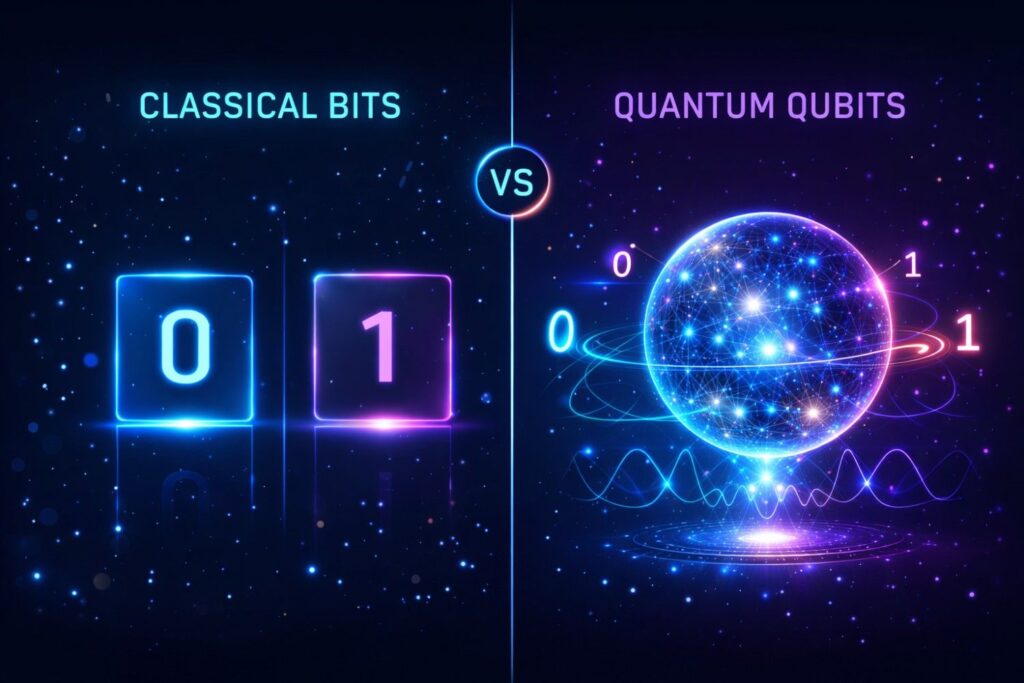
At its core, a regular computer — the one you’re reading this on right now — thinks in bits. A bit is either a 0 or a 1. On or off. Yes or no. Every calculation your laptop or phone makes is just a very fast series of these binary decisions.
Quantum computers are different. They use qubits — quantum bits — which can be 0 and 1 at the same time. This is called superposition, and it’s one of the strangest, most mind-bending properties of quantum mechanics.
But it gets even more interesting. Qubits can also be entangled, meaning two qubits can be linked so that the state of one instantly affects the other — no matter how far apart they are. Einstein famously called this “spooky action at a distance.” Today, engineers are turning it into a computing advantage.
The result? A quantum computer can explore millions of possible solutions simultaneously, rather than checking them one by one like a classical computer does. For certain types of problems — optimization, simulation, cryptography — this difference isn’t just faster. It’s a completely different league.To better understand how intelligent systems are evolving alongside computing, check out our beginner-friendly guide to AI automation.
Where We Are in 2026: From Lab to Reality
For most of the past decade, quantum computing existed primarily as a research topic — fascinating, promising, but frustratingly impractical. That’s changing fast.
In March 2026, IBM unveiled the industry’s first published quantum-centric supercomputing reference architecture — a blueprint showing exactly how quantum processors (QPUs) can work alongside traditional CPUs and GPUs to tackle scientific challenges no single computing approach can solve alone. This is a landmark moment. It signals that quantum isn’t just a standalone curiosity anymore. It’s becoming part of the computing ecosystem.
Google’s Willow quantum chip demonstrated a quantum algorithm running 13,000 times faster on a quantum processor than on classical supercomputers. That’s not a rounding error. That’s a paradigm shift.
Meanwhile, scientists in Norway recently identified signs of a triplet superconductor — a material that could transmit both electricity and electron spin with zero resistance. If confirmed, this could lead to quantum computers that are dramatically more stable and energy-efficient than anything we have today.
And in a landmark paper published in Science in early 2026, researchers from the University of Chicago declared that quantum technology has reached what they’re calling its “transistor moment” — the inflection point where theoretical foundations are solid and real-world engineering begins in earnest.
We’re not at the finish line. But we’ve just entered the race in a serious way.You can also explore the latest AI-powered tools and apps transforming everyday life in our 2026 tech roundup.
How Quantum Computers Actually Work (Simply Explained)

Let’s demystify the mechanics a bit, because understanding how this works makes everything else click.
Superposition is the ability of a qubit to exist as both 0 and 1 simultaneously. Think of a coin spinning in the air — it’s neither heads nor tails until it lands. A qubit is like a coin that never has to land until you ask it to. This lets a quantum computer process an enormous number of possibilities at once.
Entanglement links qubits together so that the state of one instantly correlates with another. Engineers use this to create powerful computational shortcuts — essentially coordinating calculations across multiple qubits in ways classical computers simply can’t replicate.
If you’re a student trying to grasp complex concepts like these, here are some powerful tools that can make learning easier.
Interference is the third key principle. Quantum algorithms are designed to amplify paths that lead to correct answers and cancel out paths that lead to wrong ones. It’s a bit like noise-canceling headphones, but for math.
Together, these three properties give quantum computers their extraordinary speed for specific problem types. The keyword is “specific” — quantum computers aren’t better at everything. They won’t make your web browser faster. But for optimization problems, drug simulations, and cryptography? They’re in a different dimension.
The 6 Biggest Quantum Computing Trends Shaping 2026
1. Hybrid Quantum-Classical Computing Is Here Now
Pure quantum computers aren’t quite ready to operate independently at scale. What is ready — and growing fast — is the hybrid approach: using quantum processors alongside classical hardware to tackle specific parts of complex problems.
IBM’s new architecture is a perfect example. It doesn’t replace classical computing. It enhances it. Think of it like a Formula 1 car that uses both an electric motor and a combustion engine — each handling what it does best.
For businesses, this hybrid model is the entry point to quantum advantage right now, today, in 2026.
2. Error Correction Is Finally Maturing
One of quantum computing’s biggest problems has been noise. Qubits are incredibly sensitive — electric and magnetic fields, vibrations, even cosmic rays can disrupt them and cause errors. This is why early quantum computers were called NISQ devices: Noisy Intermediate-Scale Quantum.
In 2026, error correction is finally coming of age. Microsoft, in collaboration with Atom Computing, plans to deliver an error-corrected quantum computer to customers this year. QuEra has delivered error-correction-ready machines to Japan’s national science institute.
Researchers at the Niels Bohr Institute have also built a real-time qubit monitoring system that tracks fluctuations happening in fractions of a second — something previously impossible. These advances are critical. Without error correction, scaling quantum computers to practical sizes is impossible.
3. Cloud-Based Quantum Access Is Democratizing the Field
You don’t need a $100 million lab to access quantum computing anymore. IBM, AWS (Amazon Braket), Microsoft Azure, and Google Cloud are all rolling out pay-as-you-go quantum access in 2026.
This matters enormously. A pharmaceutical startup in Lahore, a logistics company in Lagos, or a university lab in Karachi can now run quantum experiments the same way they’d spin up a cloud server. The barrier to entry is collapsing.
4. Quantum Is Transforming Cybersecurity — Both the Threat and the Solution
This is perhaps the most urgent quantum story of 2026.
Quantum computers, once fully mature, will be able to break most of today’s encryption — including RSA and ECC, the standards that protect your bank transactions, emails, and national security communications. This threat is real enough that the U.S. NIST has already published post-quantum cryptography standards, and organizations must comply with high-risk AI requirements including quantum-safe measures by August 2026.
But quantum also solves the security problem it creates. Quantum Key Distribution (QKD) generates encryption keys using quantum processes that are physically impossible to intercept without detection. Governments and financial institutions are already piloting QKD for the most sensitive communications.
The window to “harvest now, decrypt later” attacks is real. Bad actors are storing encrypted data today, betting they can decrypt it once quantum computers mature. If your organization handles sensitive long-term data, post-quantum migration isn’t a future problem — it’s a present one.Worried about digital threats? Learn how to protect yourself from hackers using practical and proven strategies.
5. Real-World Industry Applications Are Going Live
For years, quantum’s real-world applications existed mostly in PowerPoint decks. In 2026, pilots are becoming products.
Finance is using quantum algorithms for portfolio optimization and risk modeling — calculations that involve billions of variables simultaneously. JPMorgan, Goldman Sachs, and HSBC have all invested in quantum programs.If you’re wondering how to turn emerging technologies into income opportunities, check out our guide on making money online.
Pharmaceuticals are using quantum simulation to model molecular interactions at a level of accuracy classical computers can’t achieve — potentially cutting drug discovery timelines from 10+ years to a fraction of that.
Logistics companies are applying quantum optimization to routing problems — finding the most efficient paths for delivery networks with thousands of variables. Even a 5% improvement in routing efficiency for a company like UPS or FedEx translates to billions of dollars.
Materials science is another frontier. Quantum simulation of new materials could accelerate the development of better batteries, superconductors, and solar cells — directly impacting the clean energy transition.
6. Room-Temperature Quantum Is Getting Closer
One of the biggest practical hurdles has been temperature. Most quantum computers require cooling to near absolute zero (-273°C) — colder than outer space — to function. This demands massive, expensive cryogenic infrastructure.
In 2026, breakthroughs in trapped ion technology (pioneered by IonQ) and photonic qubits (demonstrated by Xanadu) are bringing room-temperature quantum computing closer than ever. This would be a game-changer — removing the need for expensive specialist infrastructure and opening quantum to a far wider range of deployment environments.
The Challenges: Let’s Be Honest About What’s Not Solved Yet
Quantum computing is genuinely exciting, but it would be dishonest to pretend there aren’t real obstacles.
Scalability remains the core challenge. Current machines have hundreds to thousands of qubits. Truly transformative applications — breaking encryption, modeling complex proteins — may require millions of stable qubits. We’re not there yet.
The skilled workforce gap is severe. There simply aren’t enough quantum engineers, physicists, and algorithm developers globally. Universities are racing to build quantum curricula, but supply is years behind demand.
ROI is still elusive for most organizations. Most quantum applications in 2026 are still in pilot or proof-of-concept phases. Demonstrating clear, measurable return on investment over classical alternatives remains difficult.
Integration complexity is real. Quantum systems operate on entirely different principles than classical ones. Building hybrid workflows, data pipelines, and software stacks that bridge both worlds is technically demanding.
These aren’t reasons to dismiss quantum. They’re reasons to approach it strategically — understanding where it delivers value now, and where patience is required.
What This Means for Businesses Right Now
If you’re running a business or making technology decisions, here’s the practical takeaway for 2026:
Start your post-quantum cryptography migration now. This isn’t optional if you handle sensitive data. Inventory your current encryption, identify what needs to be upgraded, and follow NIST’s post-quantum standards.
Explore hybrid quantum cloud services. IBM Quantum, AWS Braket, and Google Quantum AI all offer cloud access. Start understanding what quantum can do for your specific problem domain — optimization, simulation, or analytics.
Build quantum literacy in your team. You don’t need quantum physicists on staff, but having engineers and strategists who understand the basics is increasingly a competitive advantage.
Watch the finance and pharma sectors. They’re the canaries in the quantum coal mine. Where they go, others will follow.
Don’t overbuy the hype, but don’t miss the shift. The organizations that win with quantum will be those who begin preparing now — not those who wait until quantum advantage is obvious to everyone.
The Future: What’s Coming After 2026
IBM’s roadmap targets quantum computers capable of executing 1 billion gates on up to 2,000 qubits by 2033. Google aims for fully error-corrected quantum computers by 2029. The global quantum computing market, which exceeded $10 billion in 2026, is projected to grow explosively through the decade.
The University of Chicago’s David Awschalom put it best: “This transformative moment in quantum technology is reminiscent of the transistor’s earliest days. The foundational physics concepts are established, functional systems exist, and now we must nurture the partnerships and coordinated efforts necessary to achieve the technology’s full, utility-scale potential.”
We are, in other words, right at the beginning of something enormous. The transistor was invented in 1947. The personal computer didn’t arrive until 1975. The smartphone until 2007. History shows that transformative technologies take time to mature — but when they do, they reshape everything.
Quantum computing is on that path. And 2026 is the year the path became unmistakably clear.
Final Thoughts
Quantum computing isn’t coming. It’s here — early, imperfect, but undeniably real and moving fast.
The companies, governments, and individuals who take it seriously today will be the ones who understand and shape the quantum future when it fully arrives. That future isn’t decades away. It’s years away. And the preparation for it starts now.
Whether you’re a business leader, a student, a developer, or simply someone trying to understand the world — quantum computing is one of the most important stories of our time. Now you know what it’s about.