
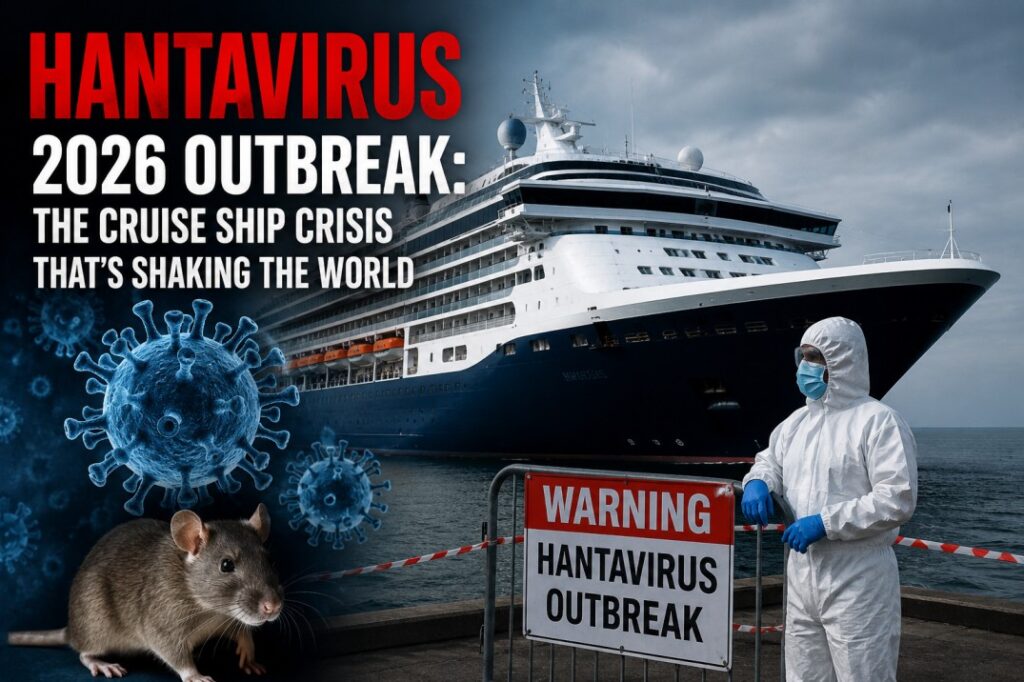
Hantavirus 2026 outbreak cruise ship crisis has become a major global health concern as cases are being reported and authorities are investigating its spread, symptoms, and prevention strategies.
Hantavirus 2026 Outbreak:
As of May 11, 2026 — Cruise ship MV Hondius reaches Canary Islands. Americans begin repatriation.
Health & Global Affairs
The Hantavirus Outbreak on a Cruise Ship Is Terrifying — Here’s What’s Actually Happening
Three people are dead. Eight are infected. The world is watching. But is this the next pandemic — or a contained tragedy at sea?
Imagine boarding a luxury expedition cruise in Argentina, sailing toward Antarctica, surrounded by breathtaking icebergs and open ocean — and then, somewhere in the middle of the Atlantic, a silent, invisible killer begins moving through the ship. That’s exactly what happened aboard the MV Hondius, and the world hasn’t been able to look away since.
8
Confirmed & Suspected Cases
3
Deaths Reported
147
People On Board
6+
Countries Involved
The hantavirus outbreak on the Dutch cruise ship MV Hondius has officially become one of the most unusual and closely watched public health events of 2026. What started as a mysterious illness among a handful of passengers in the remote South Atlantic has now spread across six countries, sparked a Level 3 CDC emergency response, and sent waves of fear through millions of people who are suddenly Googling: “What is hantavirus? Can I get it? Should I be scared?”
Let’s slow down. Let’s breathe. And let’s actually understand what’s going on — because the truth is more nuanced, more fascinating, and both more and less frightening than the headlines suggest.
First, What Even Is Hantavirus?
Most people have never heard of hantavirus before this week — and that’s actually part of the point. This isn’t a new virus that just popped into existence. Hantaviruses have been quietly living in rodents for thousands of years. There are more than 50 known types, and they infect mice, rats, and other small rodents, usually without harming the animals at all.
Humans, however, are a different story.
When humans come into contact with the urine, droppings, saliva, or nesting materials of infected rodents — especially when those materials dry out and become airborne dust — the virus can enter the respiratory system. What follows can be devastating. In the Americas, hantavirus causes something called Hantavirus Pulmonary Syndrome (HPS), which targets the lungs with terrifying efficiency. Fluid fills the lungs. Breathing becomes impossible. The heart strains to compensate. In severe cases, patients die within days of their first symptoms.
📖 Quick History Lesson
Hantaviruses were first officially identified during the Korean War in the early 1950s, when thousands of UN troops developed a mysterious hemorrhagic fever. Scientists have since discovered they’ve been infecting humans for far longer — we just didn’t have a name for it.
The Specific Villain: Andes Virus
Here’s where the current outbreak gets particularly chilling — and scientifically unique.
Among the dozens of hantavirus strains, the one responsible for the MV Hondius outbreak is called the Andes virus. And Andes virus is the black sheep of the hantavirus family. It’s the only type of hantavirus in the world that has been documented to spread from person to person.
Every other hantavirus? You can only get it from a rodent. Andes virus has broken that rule. Though rare and requiring close, prolonged contact, this ability to jump between humans is what makes this particular strain so alarming to public health experts — and so different from your typical hantavirus case.
The Andes virus is normally found in South America, primarily in Argentina and Chile. The leading hypothesis, based on investigations by Argentine health authorities, is that the index patient — a Dutch citizen who first showed symptoms — contracted the virus during a four-month road trip through Chile, Uruguay, and Argentina before boarding the ship on April 1, 2026.Read more about Nipah Virus outbreak and its deadly impact
What Happened on the MV Hondius — A Day-by-Day Breakdown
April 1, 2026
MV Hondius departs Ushuaia, Argentina, carrying 147 passengers and crew on an expedition to Antarctica and the remote South Atlantic.
Around April 6–11
The index patient, a Dutch citizen, begins showing symptoms of fever and respiratory distress. He dies on approximately April 11. His body remains aboard the ship.
April 24, 2026
The ship reaches Saint Helena island. The index patient’s wife disembarks with gastrointestinal symptoms. Separately, another passenger reports fever and signs of pneumonia to the ship’s doctor. 30 other passengers also disembark — all later traced by UK health authorities.
April 25–26
The wife boards a flight to Johannesburg, South Africa. She deteriorates mid-flight and dies upon arrival at the emergency department on April 26.
May 2, 2026
Laboratory testing in South Africa confirms hantavirus (Andes virus). The UK IHR focal point notifies WHO. The world learns about the outbreak.
May 4, 2026
WHO reports 7 cases — 2 confirmed, 5 suspected — including 3 deaths, 1 critical, and 3 mild. A third passenger dies aboard the ship. The vessel is moored off Cape Verde.
May 6–8, 2026
Andes virus officially confirmed as the cause. The ship departs Cape Verde for Tenerife, Canary Islands. Patients are now hospitalized in South Africa, Netherlands, Germany, Spain, Switzerland, and Saint Helena.
May 10–11, 2026
MV Hondius arrives in Tenerife. Passengers begin disembarking. 18 Americans (17 passengers + 1 UK resident) fly to Omaha, Nebraska for monitoring. As of May 11, none of the Americans have tested positive.
The Symptoms: What Does Hantavirus Actually Feel Like?
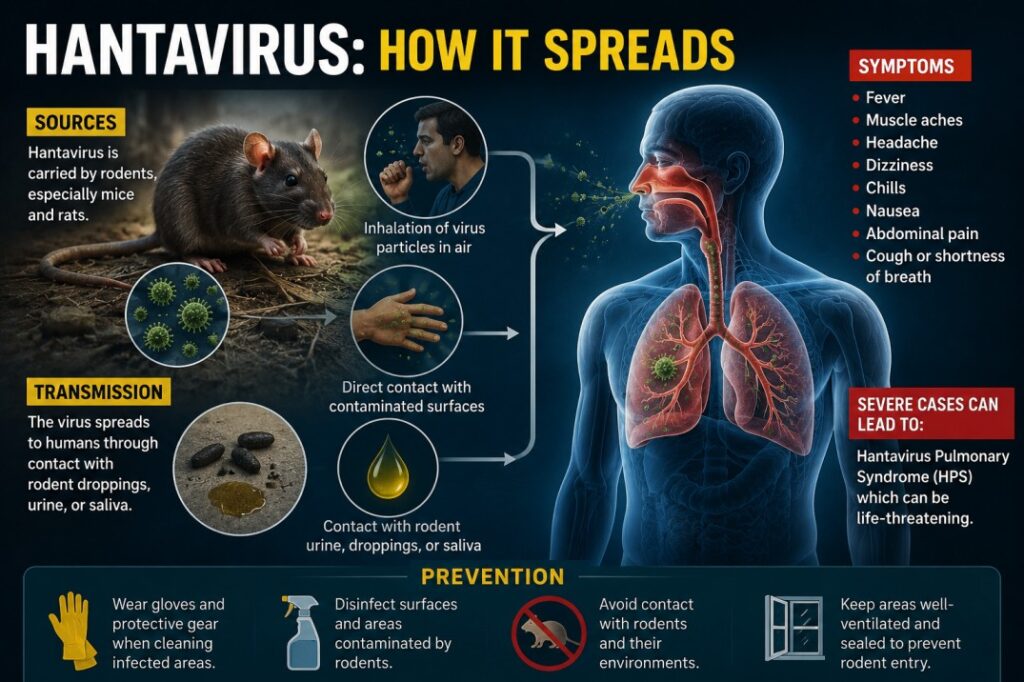
This is where hantavirus becomes genuinely terrifying — not because the symptoms are bizarre and alien, but because in the early stages, they feel like absolutely nothing. Just the flu. Just a fever. Just “feeling off.”
Symptoms of HPS from Andes virus appear anywhere from 4 to 42 days after exposure. That’s a massive window of uncertainty — and it’s one reason contact tracing has been so complex.
Early Stage (First Few Days)
🌡️ Fever and chills
😩 Severe fatigue
💪 Muscle aches in thighs, hips, back, shoulders
🤕 Headache
🤢 Nausea and vomiting (in ~half of patients)
🤧 Abdominal discomfort
Late Stage (Days 4–10) — When It Gets Dangerous
😮💨 Shortness of breath that comes on suddenly
💧 Fluid flooding the lungs
❤️🩹 Heart rate collapse
🫁 Acute respiratory distress syndrome (ARDS)
⚠️ The Cruel Twist
The early symptoms are so generic that most people would never suspect hantavirus. By the time breathing difficulties appear, the disease has already progressed aggressively. This short window between “seems fine” and “critical condition” is what makes HPS so dangerous. The CDC reports that 38% of people who develop respiratory symptoms from HPS may die from the disease.
How Does It Spread? And Should You Actually Be Worried?
This is the question on everyone’s mind. And the answer requires separating what is true from what sounds terrifying but isn’t.
Normally, hantavirus spreads like this: You go into an old barn, shed, or cabin. You breathe in dust containing dried rodent droppings or urine. The virus enters your lungs. That’s it. You cannot “catch” standard hantavirus from another person the way you catch a cold.
The Andes virus exception: This strain, uniquely, can spread from person to person. But only in very specific circumstances — close, prolonged contact with someone who is already symptomatic. This means kissing, sharing eating utensils, prolonged time together in an enclosed space, or exposure to the infected person’s respiratory secretions or body fluids.
Transmission between people has been associated with close and prolonged contact, particularly among household members, intimate partners and people providing medical care.— WHO Director-General Tedros Adhanom Ghebreyesus
The key words here are close and prolonged. This is not airborne transmission in the way COVID-19 was. You can’t get it by walking past someone on the street or being in the same building. Even the largest documented Andes virus outbreak — a 2018–2019 event in Argentina — resulted in only 34 confirmed infections, and that was from a birthday party and subsequent close contact situations.
✅ What WHO and CDC Are Saying
“I want to be unequivocal here. This is not the start of a COVID pandemic,” said Maria Van Kerkhove, WHO’s director of epidemic and pandemic management. “This is not COVID. This is not influenza. It spreads very, very differently.”
The WHO has assessed the global public risk as LOW as of May 4, 2026. The CDC considers the risk to the general US public as extremely low.
Is This the Next COVID? The Honest Answer
The internet is full of people drawing COVID comparisons, and honestly, it’s understandable. We’re all still carrying the trauma of 2020. Every new virus outbreak triggers that same primal alarm: here we go again.
But the experts are united in saying: no. This is not COVID. Here’s why they’re confident.
Dr. Carlos del Rio
Professor of Global Health & Epidemiology, Emory University
“These viruses were first identified during the Korean War. Unlike COVID-19, which was caused by a novel virus, hantaviruses have been known and studied for decades.”
Dr. Abraar Karan
Infectious Disease Physician, Stanford University
“When people deteriorate, it tends to happen quickly — in a matter of days — leading to isolation or death. So the window of when you’re going to potentially expose other people while you’re contagious is short.”
There are three critical differences between Andes hantavirus and COVID-19:
- It doesn’t spread easily. Hantavirus requires close, intimate contact — not casual proximity.
- It doesn’t mutate fast. Analysis of the Argentine outbreak showed the virus did not mutate rapidly, unlike COVID or influenza which constantly reshape themselves into new variants.
- It’s not new. We’ve been studying this virus family for decades. We understand its behavior patterns far better than we understood SARS-CoV-2 in January 2020.
Treatment: Is There a Cure?
Here’s the sobering reality: there is no specific antiviral treatment or vaccine for Andes virus, or for any hantavirus. The WHO, CDC, and ECDC all confirm this.
Treatment is supportive care — meaning doctors manage the symptoms aggressively. Oxygen therapy. Mechanical ventilation when lungs fail. Intensive care. Fluid management. Heart support. The goal is to keep the patient alive long enough for their immune system to fight back.
This is exactly why early diagnosis and access to high-quality ICU care matters so much. Patients who are identified early and receive intensive medical support have significantly better survival odds than those who reach the late respiratory stage without medical intervention.Best nutrients to strengthen immune system naturally.
🔬 Research Is Ongoing
Several research groups around the world have been working on hantavirus antivirals and vaccines for years. The urgency of this outbreak may well accelerate those efforts — much as COVID-19 fast-tracked mRNA vaccine technology. The current outbreak is prompting rapid sharing of data between Argentina, South Africa, the UK, Netherlands, and other nations.
The Global Response: What Countries Are Doing
The international coordination around this outbreak has been remarkable — and it shows how much the world has learned from COVID-19.
Argentina’s health ministry moved quickly to trace the index case’s travels across South America, and is capturing and testing rodents along the route he traveled. South Africa confirmed the diagnosis and isolated critical patients. The UK Health Security Agency traced all 30 passengers who disembarked at Saint Helena. Spain approved the ship’s docking in Tenerife despite political objections from the Canary Islands’ president. Germany and the Netherlands accepted medically evacuated patients.
The CDC sent a team directly to Tenerife to assess American passengers. All 17 American passengers tested negative as of May 10, 2026, and were flown to the National Quarantine Unit at Nebraska Medicine in Omaha — a facility specifically designed for exactly this kind of high-risk situation.
Frequently Asked Questions
Can I get hantavirus from a regular mouse in my home?
Potentially, yes — but not the Andes virus specifically. The rodents that carry Andes virus have not been found in the United States. Standard hantavirus (from deer mice, for example) exists in North America and can cause HPS, but the risk is generally associated with exposure to rodent-infested areas like cabins or sheds, not typical urban or suburban homes with ordinary pest activity.
Should I avoid cruises because of this outbreak?
Public health experts say there is no reason to avoid cruises based on this outbreak. The source of infection was almost certainly a single individual who contracted the virus from rodents in South America before boarding the ship. The circumstances — a small expedition vessel visiting remote, ecologically diverse regions — are not typical of mainstream cruise travel.
Should I avoid traveling to Argentina or Chile?
The CDC and WHO have not issued travel advisories for Argentina or Chile. Hantavirus exists in parts of South America, and travelers to rural or wilderness areas should take standard precautions — avoid rodent exposure, don’t disturb rodent habitats, don’t handle dead animals. Urban travel poses minimal risk.
What should I do if I think I was exposed?
If you have been in close, prolonged contact with a confirmed or suspected hantavirus patient, or have been in areas with known heavy rodent infestation, and you develop fever, muscle aches, or breathing difficulties within 6 weeks — contact a healthcare provider immediately and mention your potential exposure. Early intervention dramatically improves outcomes.
How contagious is Andes virus compared to COVID?
Significantly less contagious. COVID-19’s reproduction number (R₀) was estimated at 2–4 for original strains and much higher for Omicron — meaning each infected person could spread to many others in normal settings. Andes virus, even with its rare person-to-person transmission, requires close physical contact or exposure to bodily fluids. Its spread has historically been contained to household members and intimate contacts.
✦ ✦ ✦
The Bigger Picture: What This Outbreak Teaches Us
There is something deeply human about following an outbreak like this — the way a ship full of strangers, united by a shared love of adventure, suddenly finds themselves at the center of a global health event. The passengers who boarded the MV Hondius in April were seeking wonder: Antarctica’s ice shelves, the wild Atlantic, remote islands few people ever see. What they found instead was a crash course in how viruses move through human populations.
But this outbreak also reveals the quiet progress that public health has made since the dark days of early COVID. The notification reached the WHO within days of the first confirmed case. Countries coordinated instead of closing borders. Science teams shared data across continents. Contact tracing was activated on flights, remote islands, and in six different countries simultaneously. Patients were evacuated safely. A ship was allowed to dock in Spain despite political tension, because the pragmatic, human decision was made.
None of that would have happened as smoothly five years ago.
The world is better prepared. Not perfect — there’s still no vaccine, no antiviral, no easy solution. But better. And that matters.
The current hantavirus outbreak is a tragedy for the families of the three people who have died. It is a frightening experience for the eight people who were infected and their loved ones. It deserves serious attention, serious science, and serious journalism.
What it does not deserve is panic.
Stay informed. Keep perspective. Trust the process — and the professionals who are, right now, working around the clock to make sure this tragedy stays contained to the terrible losses that have already occurred.
📌 Key Takeaways
• The Andes hantavirus outbreak on the MV Hondius cruise ship has caused 3 deaths and 8 cases as of May 11, 2026.
• Andes virus is unique — the only hantavirus that can spread person-to-person, but only through close, prolonged contact.
• WHO and CDC confirm global public risk is LOW. This is not a COVID-like pandemic threat.
• There is no specific antiviral treatment or vaccine. Supportive ICU care is the primary treatment.
• The outbreak is being managed through coordinated international response across multiple countries.
• American passengers have tested negative and are being safely monitored in Nebraska.
Sources: WHO Disease Outbreak News (DON599), CDC HAN Health Advisory #528, CDC Hantavirus Situation Summary, Wikipedia MV Hondius Hantavirus Outbreak, NPR, Today.com, ABC News Live Updates — all as of May 11, 2026.